

Industrial companies constantly swing between overload and underload. This volatility makes planning fragile and execution reactive. A simple yet underused tool exists to stabilize operations and create shared visibility: capacity tunnels.
By defining a realistic corridor between minimum and maximum acceptable capacity, capacity tunnels allow manufacturers to avoid planning “in the dark” and to transform theoretical schedules into robust, actionable plans.

What Are Capacity Tunnels in Manufacturing?
In supply chain management, a capacity tunnel (sometimes also called a capacity corridor) is a planning concept that defines the acceptable upper and lower capacity limits for production, transportation, or warehousing compared to the planned workload, over a given time horizon. Properly set up and managed, they help to:
- Anticipate peaks and troughs in demand,
- Evaluate the resilience of workload plans, and allow fast arbitration
- Provide controlled flexibility without losing control which insures a stable production
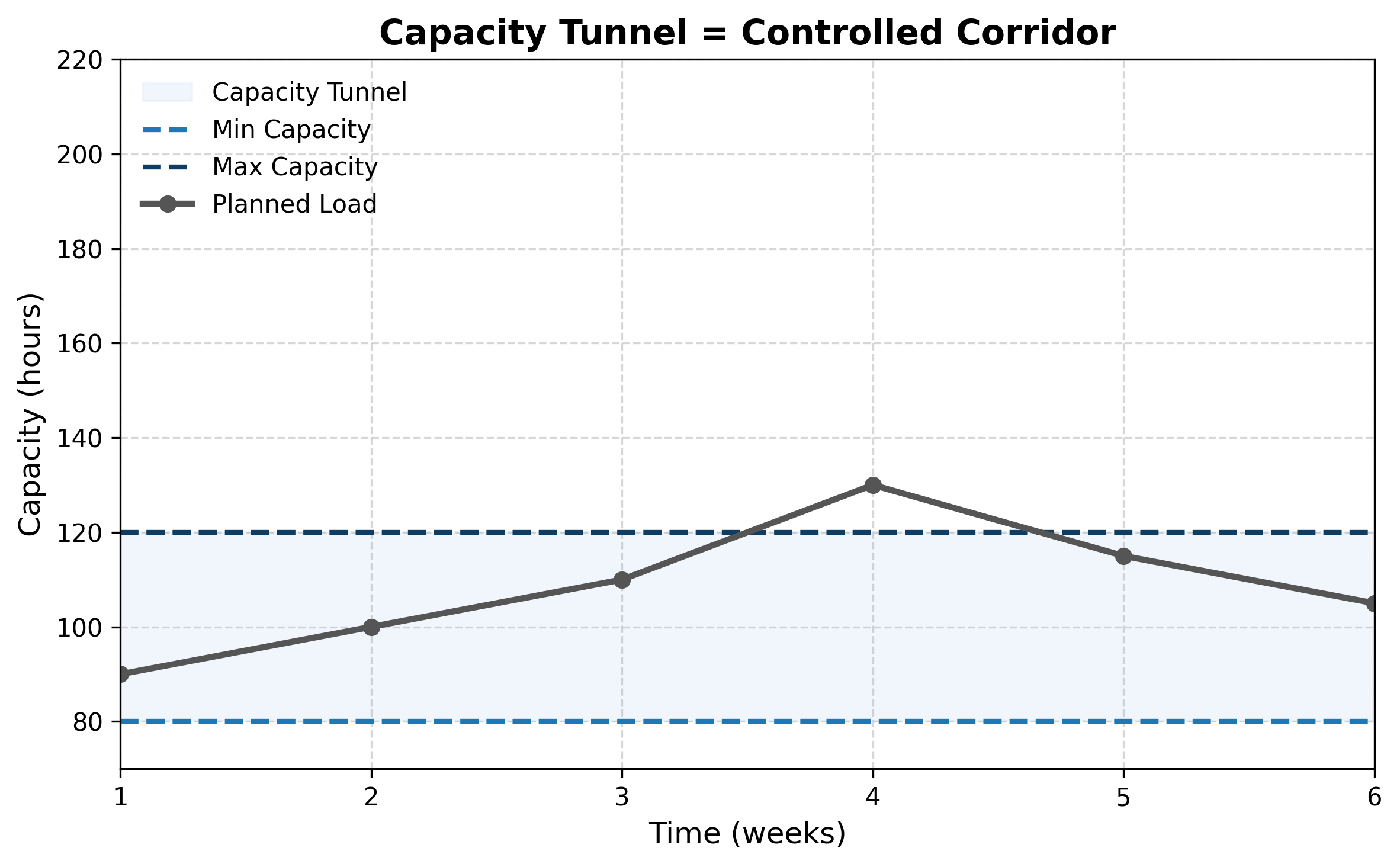
👉 Example: “On this line, I can operate safely between 80% and 120% of my nominal capacity. Below that, I waste resources; above that, I require overtime or subcontracting.”
How to Build a Capacity Tunnel
Building effective tunnels requires both technical accuracy and business pragmatism:
- Define nominal capacity → machine time, available workforce, production rate.
- Set realistic thresholds:
- Minimum capacity → under which resources are underutilized.
- Maximum capacity → beyond which extra costs (overtime, subcontracting, quality risks) arise.
- Plot the tunnel over time → daily, weekly, or monthly, depending on planning horizons.
- Overlay planned load → instantly visualize when the organization is in the “green tunnel” or drifting out.
Use Across Different Horizons
- Short term (execution): weekly monitoring, with alerts when thresholds are exceeded.
- Medium term (tactical): S&OP or MPS simulations, to arbitrate between sales ambitions and production capabilities.
- Long term (strategic): capacity sizing for investments, automation, recruitment, or outsourcing.
Benefits of Capacity Planning with Tunnels
In an industrial environment, resource capacity is never infinite: machines, operators, and production lines have physical limits. The capacity tunnel enables you to:
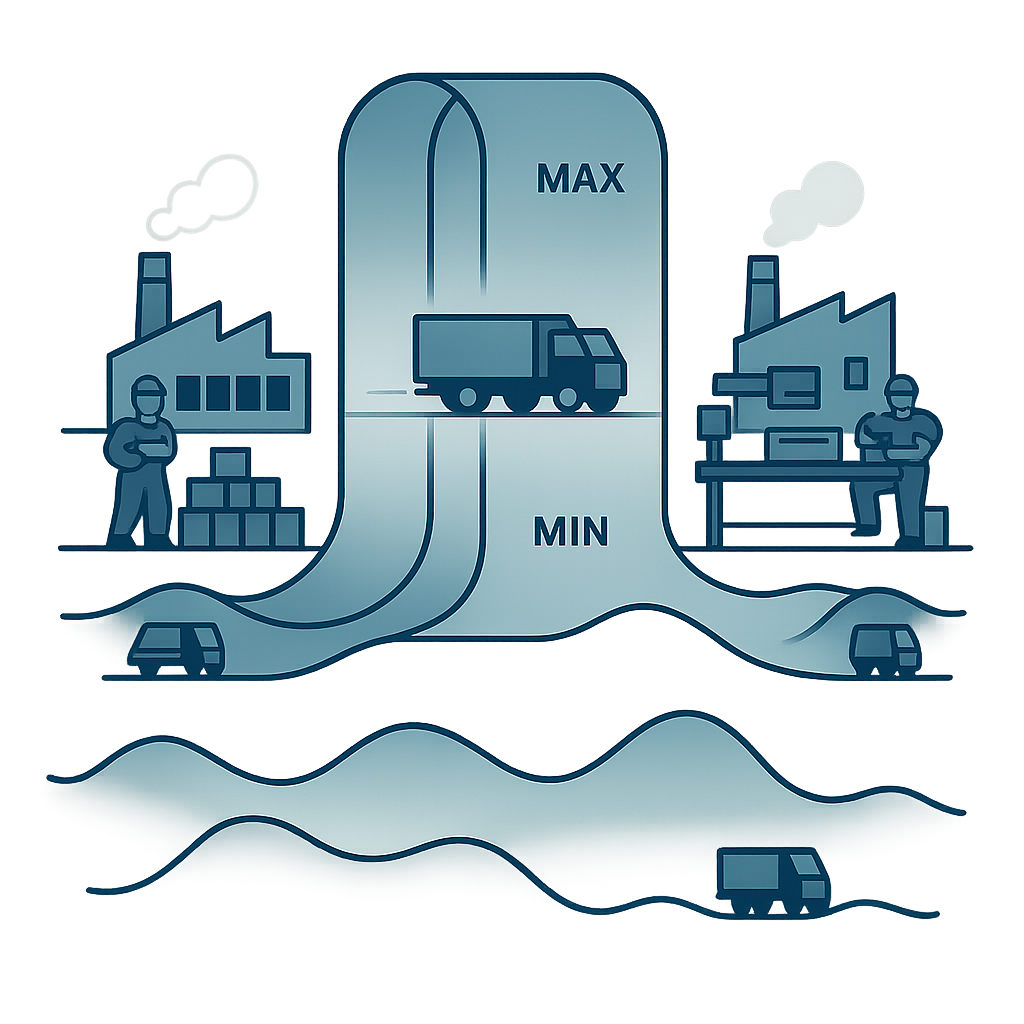
✔️ Stabilize planning and reduce firefighting by anticipating overload periods
✔️ Give visibility and create a common language between production, supply chain, and Management
✔️ Detect deviations early, before they escalate
✔️ Facilitate trade-offs: overtime, subcontracting, shifting orders, or even rebalancing product mix
✔️ Build organizational confidence: decisions are no longer based on gut feeling but on clear tunnels.
✔️ Economic impact: The tunnel links capacity to profitability. Each choice is guided by ROI and marginal cost, not just technical feasibility.
Practical Example: Capacity Tunnel in a Plastics SME
A plastics SME with 4 injection presses:
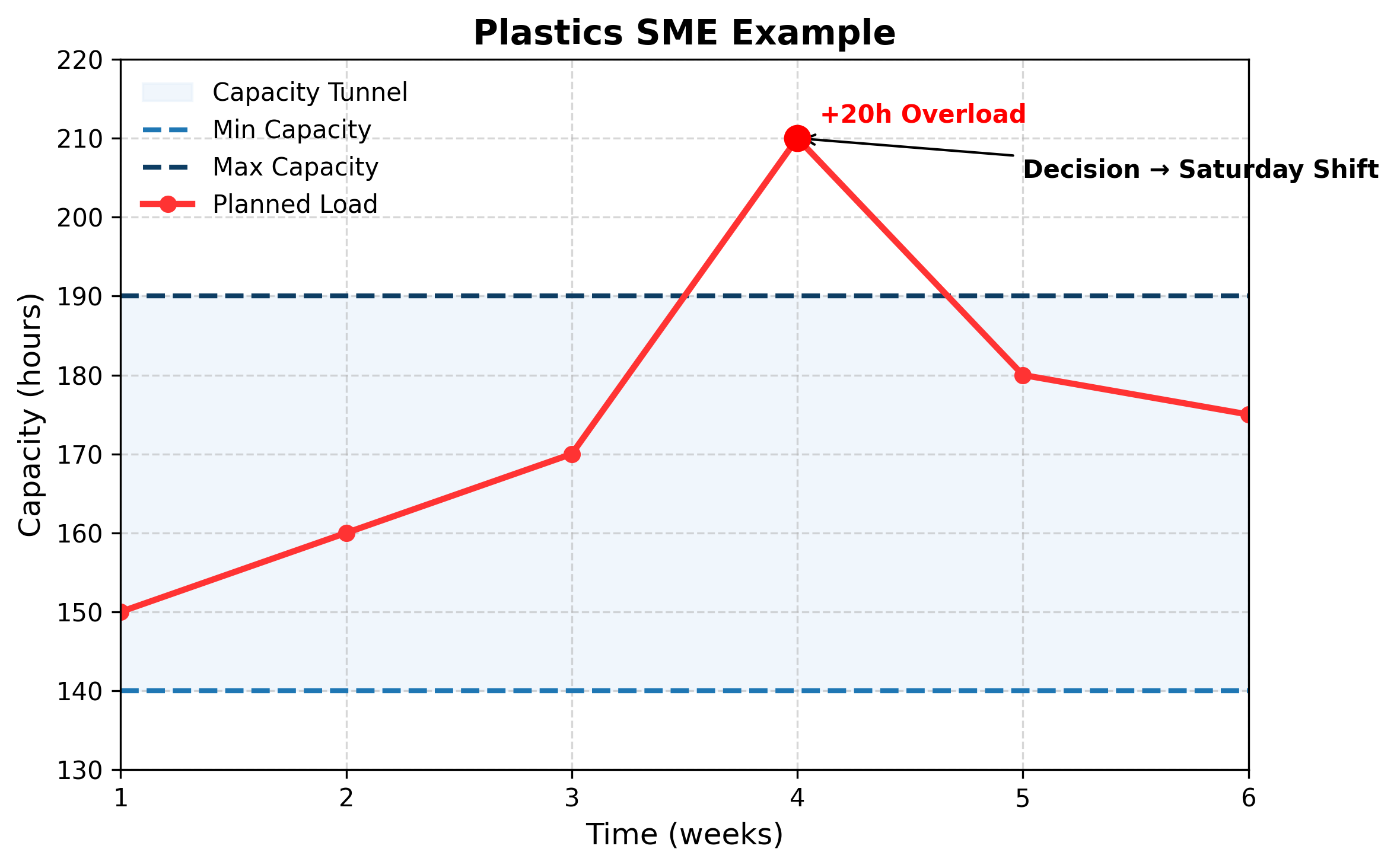
- Nominal capacity = 160 h/week
- Tunnel defined = 140 h (min) – 190 h (max)
- Projected load on week 4 = 210 h → overload of +20 h
👉 Decision: schedule an exceptional Saturday shift rather than risk subcontracting delays.
Result: customer commitments met, costs controlled, and no panic-driven decisions.
Now imagine this approach scaled to multiple plants: tunnels become a portfolio view of capacity resilience, guiding where to allocate production or investments.
Digital Tools for Capacity Planning
ERP/MES load vs. capacity modules (SAP, Odoo, Sage X3)
Advanced Planning Systems (APS) like Ortems, Preactor, Asprova → simulate multiple scenarios and bottlenecks
Excel with dynamic charts → still highly effective for SMEs starting simple
Best Practices to Optimize Capacity Management
- Continuously adjust tunnel thresholds based on shop floor feedback (real-world variability matters).
- Don’t chase 100% utilization → it’s rigid, unrealistic, and leads to hidden losses.
- Factor in variability: absenteeism, breakdowns, quality rework, supplier delays.
- Institutionalize a weekly ritual: review load vs. tunnel with supply chain, operations, and sales together.
- Use tunnels not only as a monitoring tool, but as a decision-making framework across functions.
Conclusion: From Reactive to proactive planning
Capacity tunnels are more than a scheduling gimmick—they are a resilience tool. They bring stability, transparency, and cross-functional alignment, turning uncertainty into managed flexibility.
In a world where volatility is the new normal, capacity tunnels empower manufacturers to move from reactive firefighting to proactive control.
👉 Simple in concept, yet extremely powerful when applied consistently.
Want to go further with Capacity Tunnels?

👉 Download our free full PDF guide on capacity tunnels + ready-to-use Excel template
✓ Understand capacity tunnels in depth
✓ Apply them with a ready-to-use Excel model
Tech Chain Crafter on Social Media